Pneumatic Valves — Coaxial vs. Ball: Technical Selection Criteria
Engineering comparison between coaxial pneumatic valves (axial linear motion) and actuated ball valves (90° quarter-turn): cycle frequency, differential pressure, pressure drop (Kv/Cv), and installation footprint.
When automating gas distribution networks, process skids, and emergency shut-off systems, choosing between a coaxial pneumatic valve (axial linear motion) and a pneumatically actuated ball valve (90° quarter-turn rotation) directly impacts seat life, instrument air consumption, response speed, and line pressure drop.
Golden Rule of Valve Selection
The optimal valve design depends on actual process conditions (cycle frequency, differential pressure, required Kv/Cv, and installation envelope) — not solely on nominal opening or closing speed.
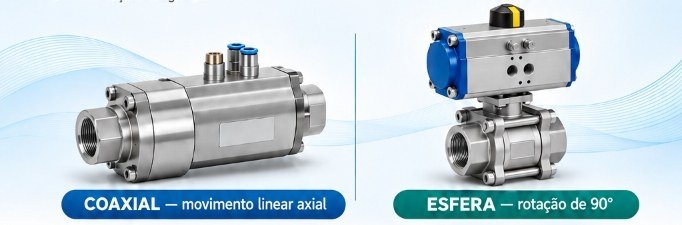
COAXIAL — Axial Linear Motion
- Compact construction: pneumatic actuator integrated directly into the valve body.
- Fast, frequent cycling: engineered for high cycle rates per hour.
- Pressure stability: minimal sensitivity to differential pressure in pressure-balanced designs.
BALL VALVE — 90° Quarter-Turn Rotation
- Full-port availability: ultra-low pressure drop and unobstructed flow path.
- Broad availability: easy standardization across larger pipe diameters and pressure classes.
- Cost-effective: external rack-and-pinion or scotch-yoke actuator with straightforward maintenance.
Technical Performance Comparison
| Criterion | Coaxial Pneumatic Valve | Pneumatic Ball Valve |
|---|---|---|
| Motion | Axial linear | 90° rotary (quarter-turn) |
| Installation Footprint | Generally compact (internal actuator) | External mounted actuator |
| High Cycle Duty | Frequently favorable* | Depends on seat design and actuator torque sizing |
| Differential Pressure | Lower influence in balanced models | Directly affects required breakaway torque |
| Pressure Drop | Depends on internal Kv/Cv geometry | Very low when specified as full-bore (full port) |
| Initial Cost | Can be higher | Generally competitive |
When to Recommend Each Technology
- Recommend Coaxial Valve: High-frequency cycling, tight space constraints inside gas panels or skids, fast switching requirements, and high differential pressure applications.
- Recommend Pneumatic Ball Valve: Standard automatic isolation in gas distribution headers, larger line sizes, full-bore low-pressure-drop requirements, and plant-wide maintenance standardization.
Pre-Specification Engineering Checklist
- Fluid and temperature: phase, required purity, viscosity, and operating temperature range.
- Inlet and differential pressures (ΔP): maximum working pressure and maximum ΔP across the closed seat.
- Flow coefficient (Kv / Cv) and allowable pressure drop: proper sizing to avoid choking the downstream process.
- Seals and seat leakage class: chemical compatibility of elastomers/PTFE with the process gas or liquid.
- Cycles per hour and closing time: actuation frequency and required emergency response speed.
- Fail-safe position and safety logic: Normally Closed (NC), Normally Open (NO), or Double Acting (DA).
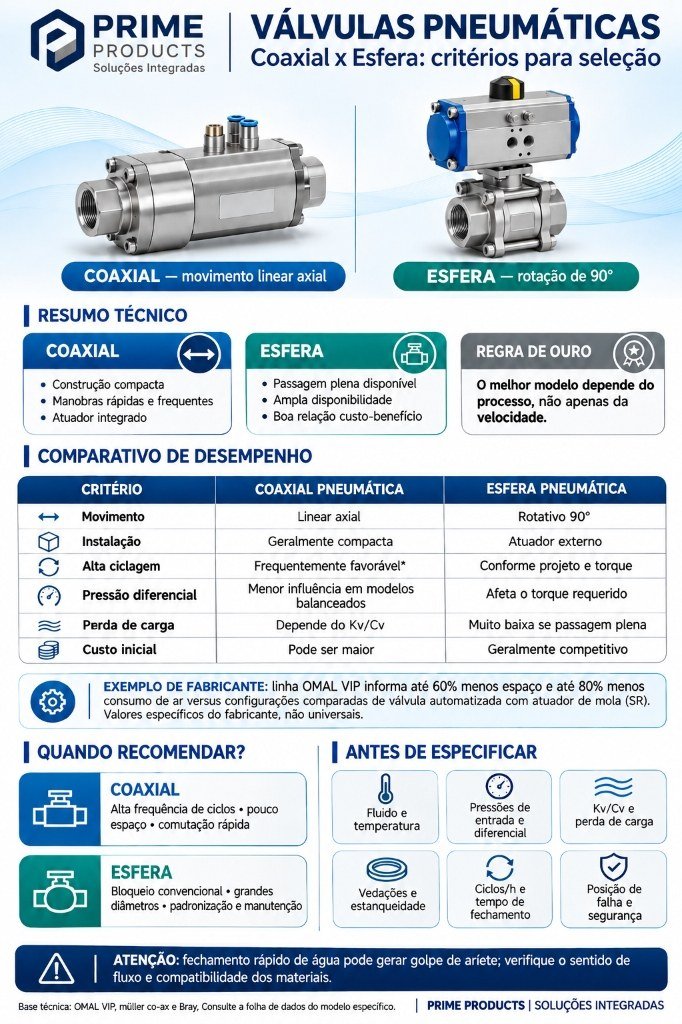
Quick-Reference Summary Infographic
Request Information
Our technical team is ready to serve your demand.
Technical Gallery